Toxic Waste Treatment
Toxic waste treatment process at Navoi State University of Mining and Technologies
Description
Navoi State University of Mining and Technologies generated in
total 2.5 tons of toxic waste in 2024. In 2025, the amount of
toxic waste was 2.3 tons. This included electronics and chemical
waste from the university labs. During 2025, through initiatives
of reduction, reusing, down-cycling and up-cycling, 1.93 tons of
toxic waste was treated effectively in total, which amounts to the
84% of the entire toxic waste produced in 2025 (2.3 tons).
Our university aims to ensuring that toxic waste is managed
responsibly and safely. All chemical and electronic waste is
carefully collected and stored in a designated room on the
university campus. Our university cooperates with local
organizations to ensure that all toxic materials are recycled
effectively and processed properly. For instance, under the terms
of an established agreement, work is being carried out in
cooperation with the Navoi Mining and Metallurgical Combine (NMMC)
on the processing and disposal of laboratory chemical waste. The
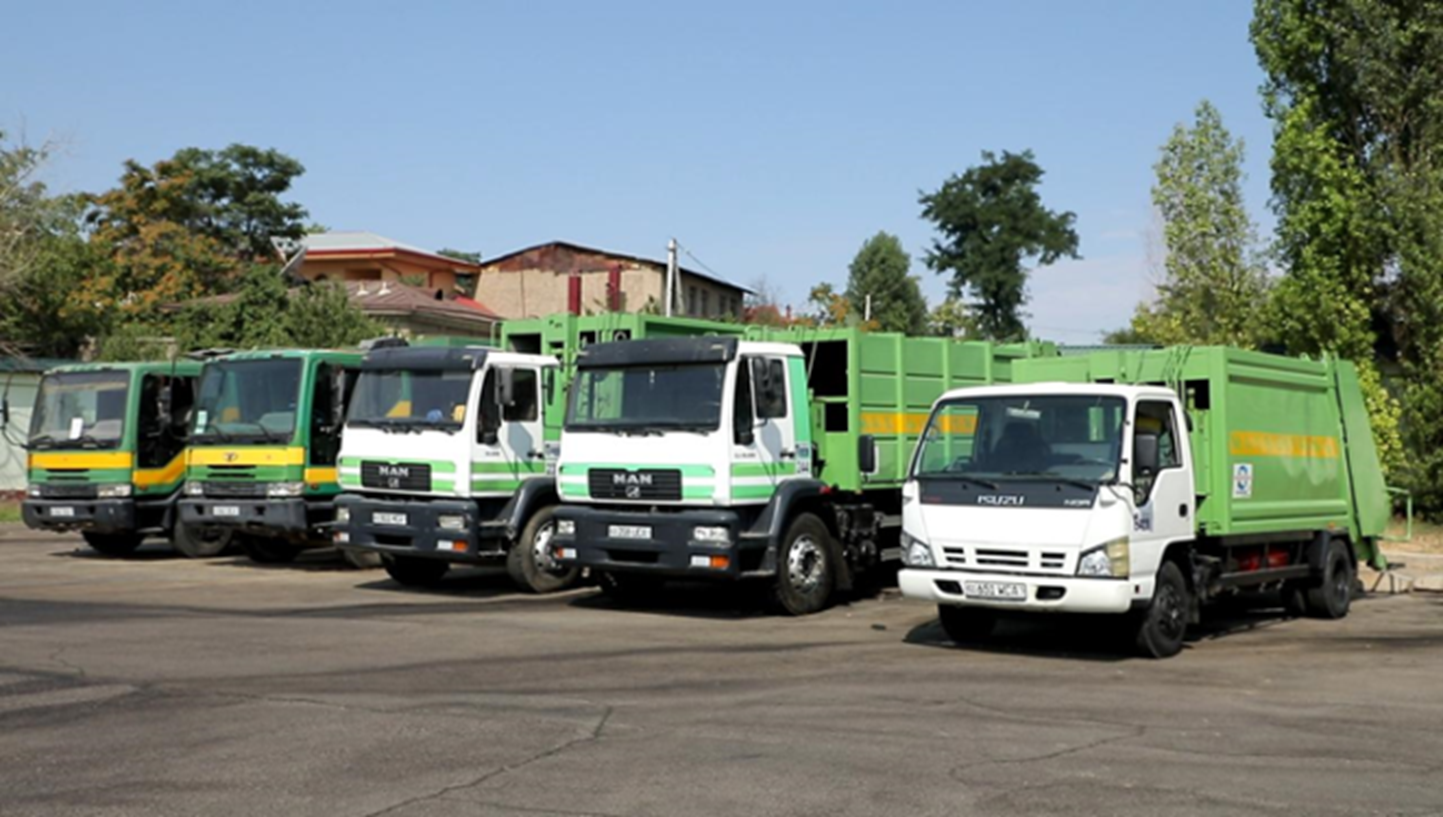
chemical waste accumulated at the university is collected and
transported in specially designed containers via trucks by
specialists from the Central Laboratory of NMMC. A portion of this
waste is processed, while the unusable part is completely disposed
of in accordance with established procedures to ensure that no
harmful substances are released into the environment. This
collaboration allows us to handle hazardous materials in a safe
and regulated manner.
A number of initiatives are being carried out in the field of
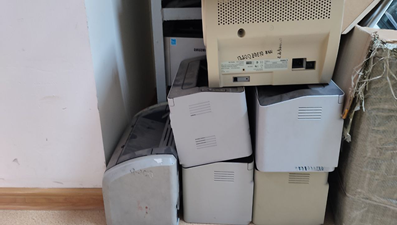
electronic waste recycling. These efforts primarily focus on
recycling or repurposing components from outdated computers,
printers, and similar technical equipment. Parts such as hard
drives, memory chips, and other functional components are assessed
for reuse. These components are then used to repair or upgrade
other equipment, extending its lifespan and reducing the need for
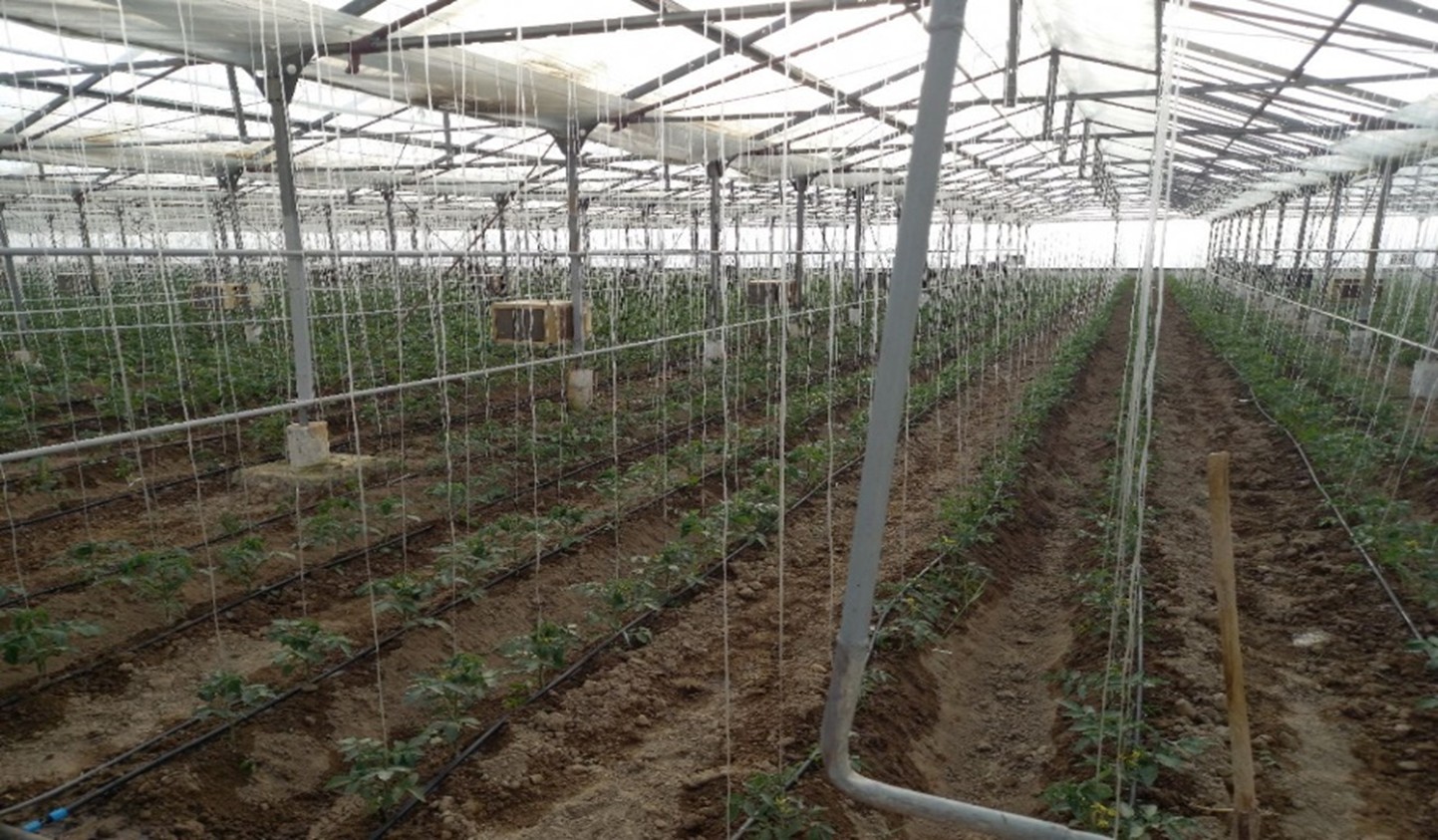
new materials. For instance, outdated household air conditioners
are refurbished and repurposed by university researchers to
function as heat exchangers in the university greenhouse. These
initiatives contribute to achieving several key sustainability
goals at the university, including repurposing electronic waste
generated on campus.
Furthemore, Associate Professor Umidjon Khujamov from the
Metallurgy Department has conducted scientific research in the
field of electronic waste recycling and successfully defended his
doctoral dissertation. The aim of the research is to study and
develop an efficient technology for processing electronic waste.
The object of the research is printed circuit boards of personal
computers. The scientific novelty of the research is as follows:
- it was determined that the most optimal process for primary
processing of printed circuit boards is heat treatment at 2500C,
allowing easy separation of metal inclusions into a separate
product;
- in the process of pneumatic separation of products after thermal
treatment and grinding the optimal class of particle size (-0.125
mm) and the dependence of the degree of extraction of valuable
components on the size of the grinded product were determined;
- the influence of temperature, concentration and time of the
process on the technological parameters of the process of sulfuric
acid treatment of the combined product was determined;
- the technology of processing of printed circuit boards using
pyro- and hydrometallurgical processes allowing to extract 86 % of
zinc and 95.7 % of copper has been developed.
On the basis of the obtained scientific results on research and
development of effective technology for processing of electronic
scrap:
- the leaching process with a dilute sulfuric acid solution during
the processing of printed circuit boards has been implemented at
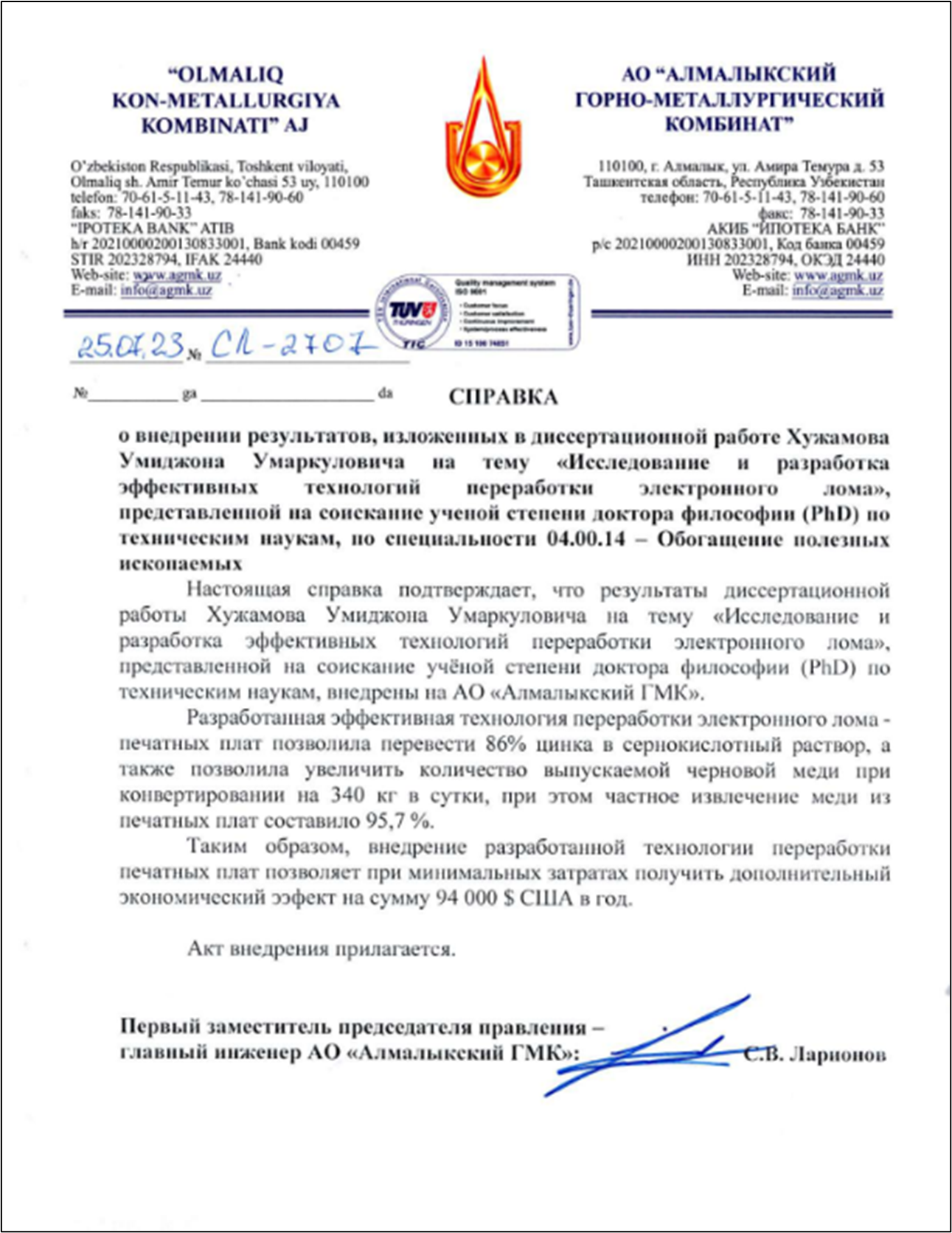
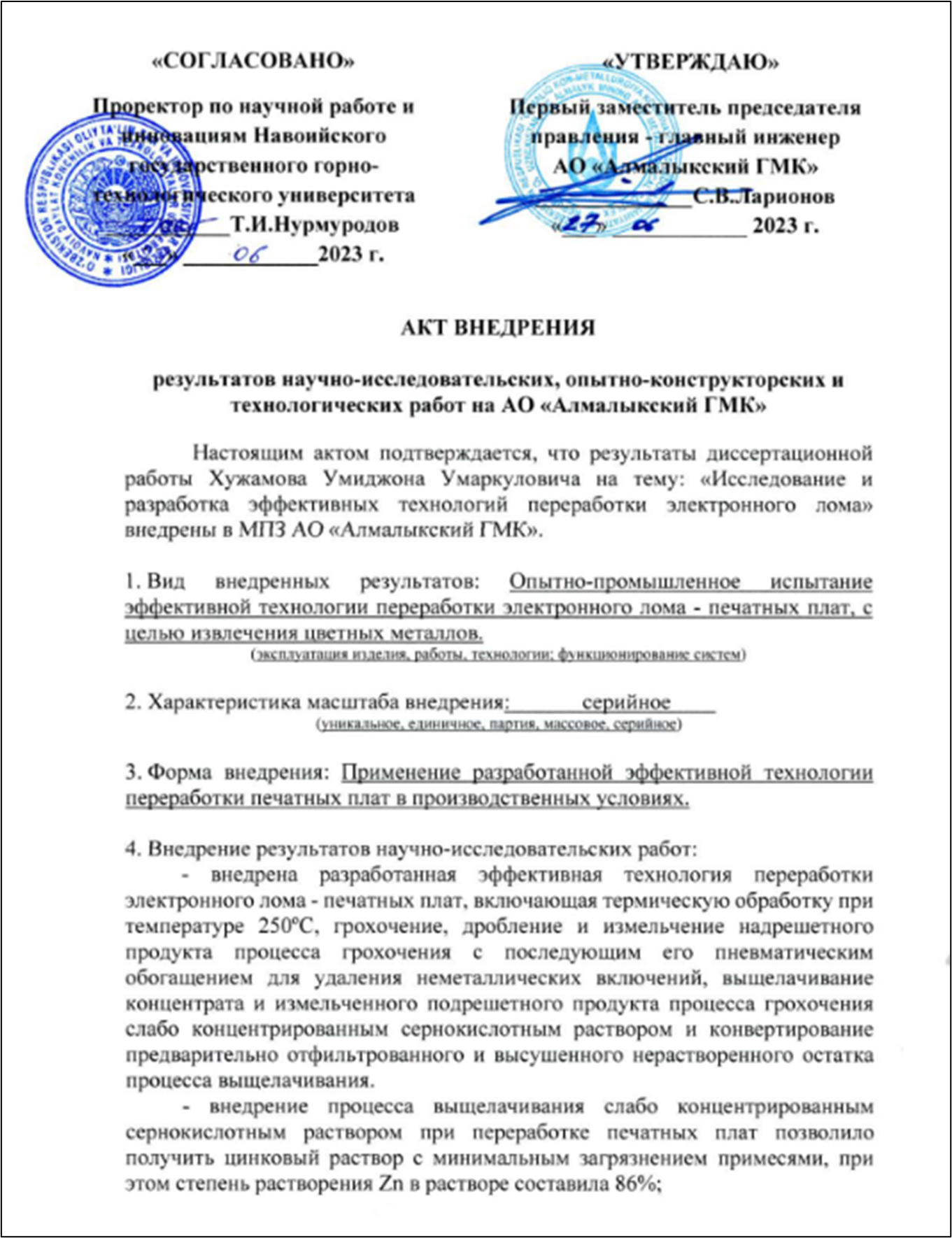
Almalyk Mining and Metallurgical Combine (certificate of the
Almalyk Mining and Metallurgical Combine No. SL-2707 dated
25.07.2023). As a result, a zinc solution with minimal impurity
contamination was obtained, while the dissolution degree of Zn in
the solution made 86%.
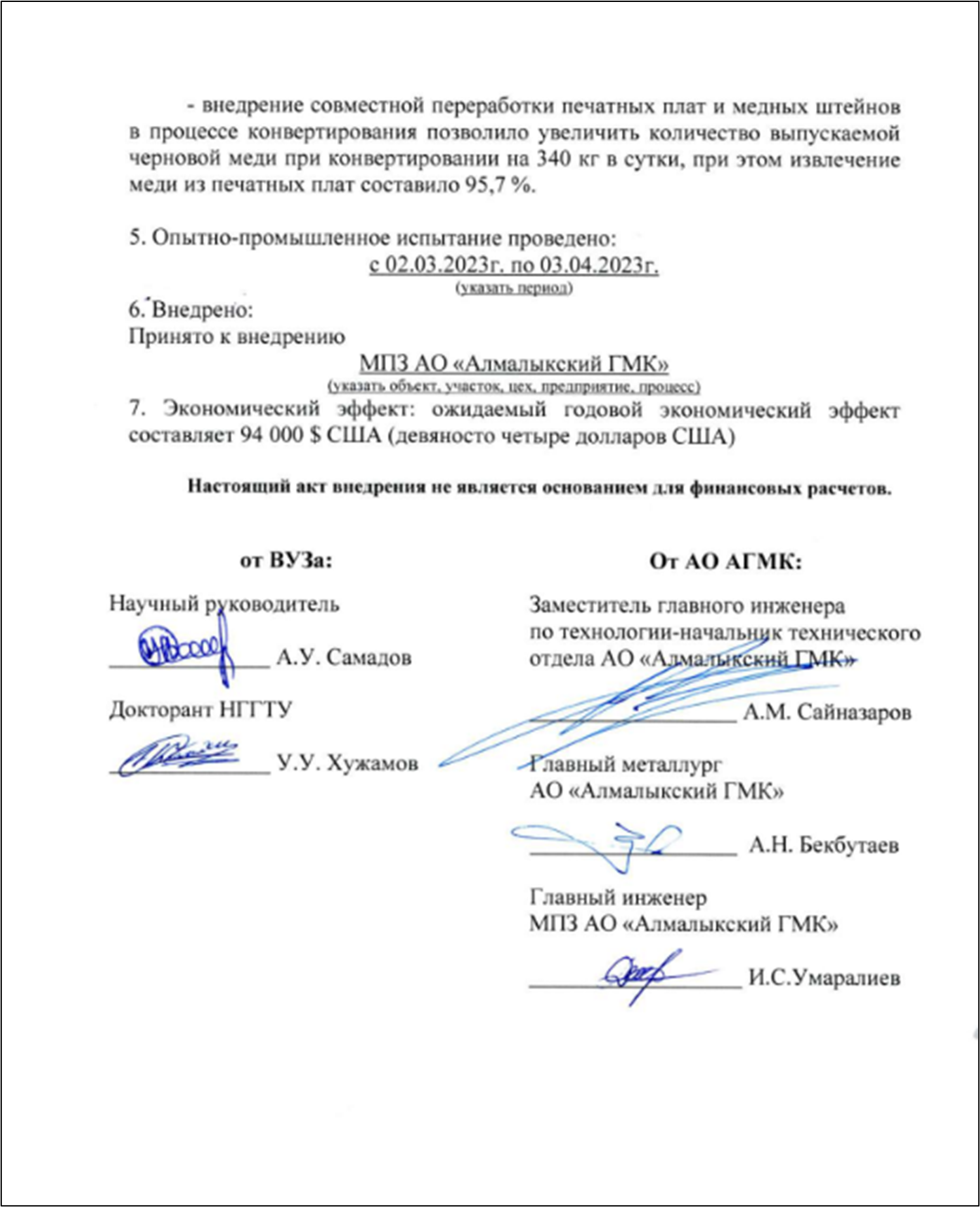
- the technology of joint processing of printed circuit boards and
copper matte in a converter has been implemented at Almalyk Mining
and Metallurgical Combine (certificate of the Almalyk Mining and
Metallurgical Combine No. SL-2707 dated 25.07.2023). As a result,
it was possible to increase the amount of rough copper received in
the process of melting in the converter by 340 kg per day and
copper recovery from printed circuit boards by 95.7%.
The ongoing efforts at the university have made it possible to
recycle a certain portion of electronic waste. In particular,
while the amount of electronic waste generated at the university
was 0.9 tons in 2023, it decreased to 0.5 tons in 2024 and has
reached 0.4 tons as of December 2025. Of this amount, 0.03 tons
were directed for reuse, and an additional 0.3 tons were allocated
for recycling in cooperation with major enterprises such as the
Almalyk Mining and Metallurgical Combine. As a result, 82.5% (0.33
tons) of the 0.4 tons of electronic waste was processed for reuse
and recycling purposes.
The amount of chemicals generated at the university decreased to 2
tons in 2024 and has reached 1.9 tons as of December 2025. Of this
amount, 1.6 tons were down-cycled. As a result, 84.2% of the 1.9
tons of electronic waste was processed for reuse and recycling
purposes. Although the overall volume of the toxic waste at the
university has been steadily declining year by year, the amount
being recycled continues to grow consistently.