Impact of Setting and Infrastructure programs in supporting the Sustainable Development Goals (SDGs)

Setting and Infrastructure initiatives of Navoi State
University of Mining and Technologies (NSUMT) contribute to
the achievement of the majority of the UN Sustainable
Development Goals (SDGs). The university's infrastructure
programs are designed not only to enhance operational
efficiency and safety, but also to promote long-term
sustainability, inclusivity, and ecological balance. These
programs have a very high impact across environmental,
social, and economic dimensions.
1. Sustainable Land Use and Green Spaces
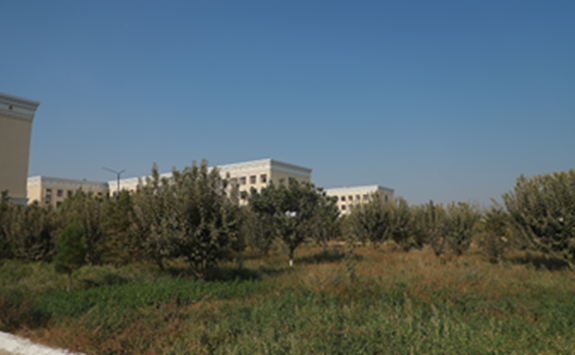
NSUMT maintains an open campus layout, where 80% of the
total land area is dedicated to open space. Notably, 49.6%
of the campus is covered in planted vegetation (99,826 m²),
and an additional 49,268 m² (24.4%) is designated for forest
vegetation. These spaces play a crucial role in climate
regulation, biodiversity support, and water management. Our
porous pavements and gravel surfaces (52,278 m²) support
storm water absorption and reduce runoff. These efforts made
by university staff support SDG 6, SDG 11, SDG 13, SDG 15.
2. Smart and Energy-Conscious Infrastructure
In line with our Smart Campus Strategy, NSUMT has adopted
modern ICT tools such as AutoCAD, EDO (online platform for
exchanging documents to reduce the use of paper and
bureaucracy), and Hemis (online platform for students and
teaching staff to manage academic aspects) for digital
planning, centralized monitoring, and academic
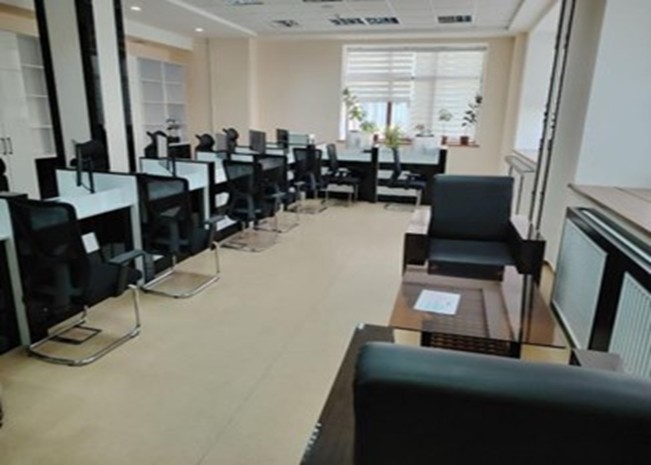
administration. Smart classrooms and laboratories are
equipped with energy-efficient ventilation, automated
lighting, face ID access systems, and fire detection
technologies. These efforts foster efficient resource use
and institutional innovation and supports SDG 7, SDG 9, SDG
12.
3. Health, Safety, and Accessibility
The university provides fully equipped medical facilities,
accessible toilets and ramps, designated parking for
individuals with disabilities, audiobooks for visually
impaired students, and lactation rooms for nursing mothers.
Safety measures include CCTV surveillance, fire alarm
systems, and emergency response protocols. These
infrastructure facilities support SDG 3, SDG 5, and SDG 10.
4. Education, Industry Linkages, and Capacity Building
With 10,753 students, NSUMT provides education and practical
training in fields such as mining, metallurgy, energy,
chemical technologies, and agriculture. Through partnerships
with national industries like Navoi Mining and Metallurgy
Combine, "Navoiyuran", and others, we integrate real-world
skills and research into our infrastructure development.
These efforts foster to implement SDG 4, SDG 8.
In conclusion, with its Setting and Infrastructure
initiatives Navoi State University of Mining and
Technologies actively supports 12 out of the 17 SDGs (SDG 3,
4, 5, 6, 7, 8, 9, 10, 11, 12, 13, 15). The scale and
integration of our efforts reflect a Very High Impact on
sustainable development – in alignment with global
priorities and national strategies. These achievements are
made possible through cross-departmental collaboration,
ICT-enabled governance, and a long-term commitment to
improving quality of life for all campus stakeholders.